Do CNC Parts Need an MOQ?
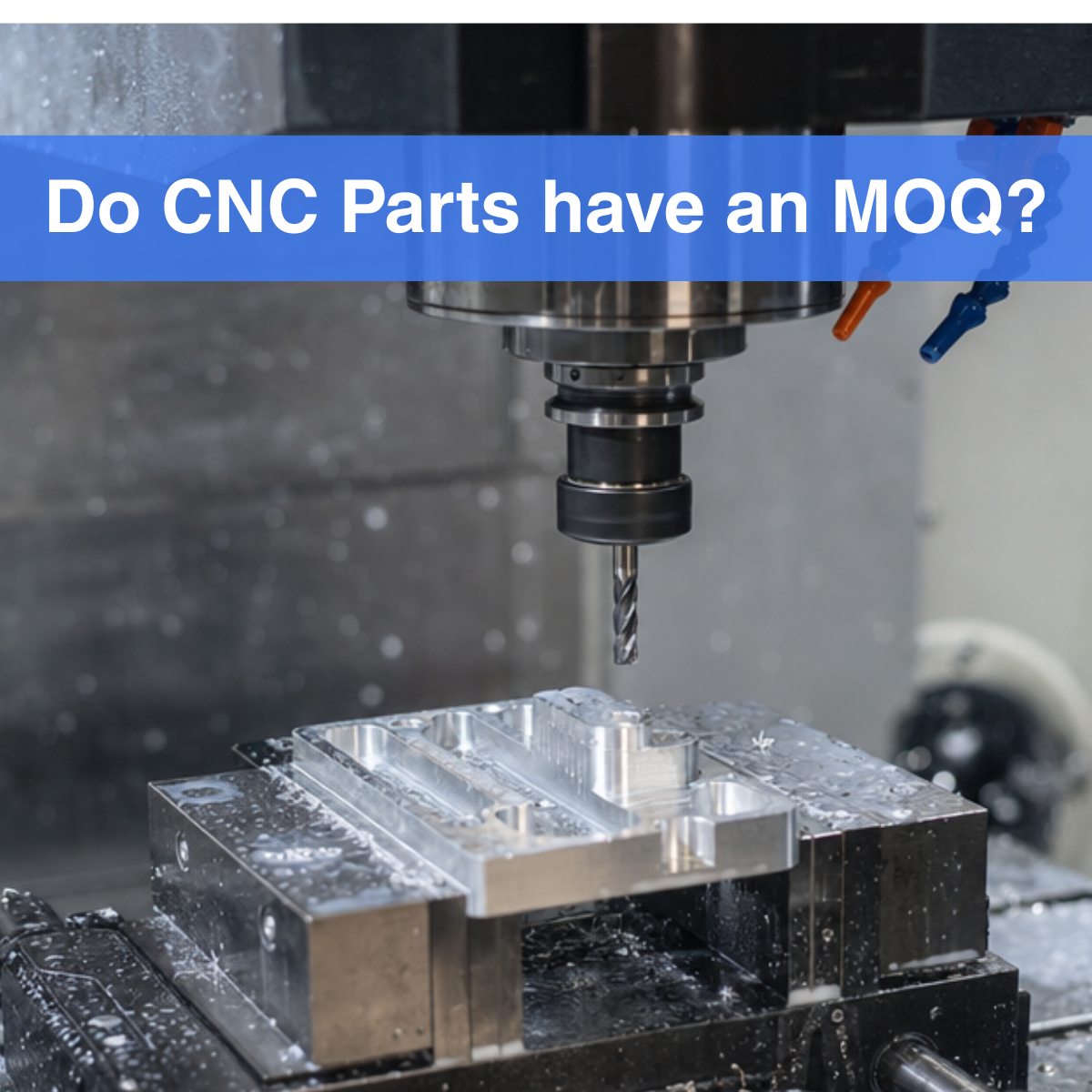
The MOQ for CNC parts is one of the first numbers on a quote, and it varies more between suppliers than most other line items. Sometimes the minimum order quantity is one part, sometimes it is five, sometimes it is fifty. It is not always obvious where the number came from or whether it is negotiable.
This post covers what an MOQ is, why minimums exist in manufacturing, how CNC machining differs from processes that require hard tooling, and what actually drives the minimum on a CNC quote. Every supplier sets its own minimums based on how its shop is set up and what it is built to run, so the goal here is to explain the factors behind the number rather than to say what the number should be.
What Is a Minimum Order Quantity?
A minimum order quantity, or MOQ, is the smallest quantity a supplier will accept on an order. Below that number, the supplier either declines the job or quotes it in a way that makes it unattractive.
MOQs exist because manufacturing carries costs that do not scale with quantity:
- Tooling. A mold, die, or stamping tool costs the same whether it produces one part or one hundred thousand.
- Setup. Machine changeover, fixturing, programming, and first article inspection take roughly the same time regardless of run length.
- Material minimums. Mills and material suppliers sell in standard sizes and quantities. Buying a single small piece of a specialty alloy is often not possible at a reasonable price.
- Order overhead. Quoting, purchase orders, inspection, packing, and shipping cost about the same on a one part order as on a five hundred part order.
An MOQ is not the same thing as a price break. A supplier can accept an order for one part and still charge far more per part than they would at quantity 500. That is normal. The MOQ is a hard floor. The price break is a sliding scale. The difference matters: one is a question of cost, the other is a question of whether the order is possible at all.
How CNC Differs From Tooled Processes
The largest driver of MOQs in manufacturing is hard tooling, and CNC machining does not have any.
Injection molding requires a mold. Die casting requires a die. Stamping requires a die set. Those tools cost thousands to tens of thousands of dollars and take weeks to build. No supplier is going to build one to produce a single part, so the MOQ gets set at whatever quantity makes the tool investment reasonable. The minimum comes from the process itself.
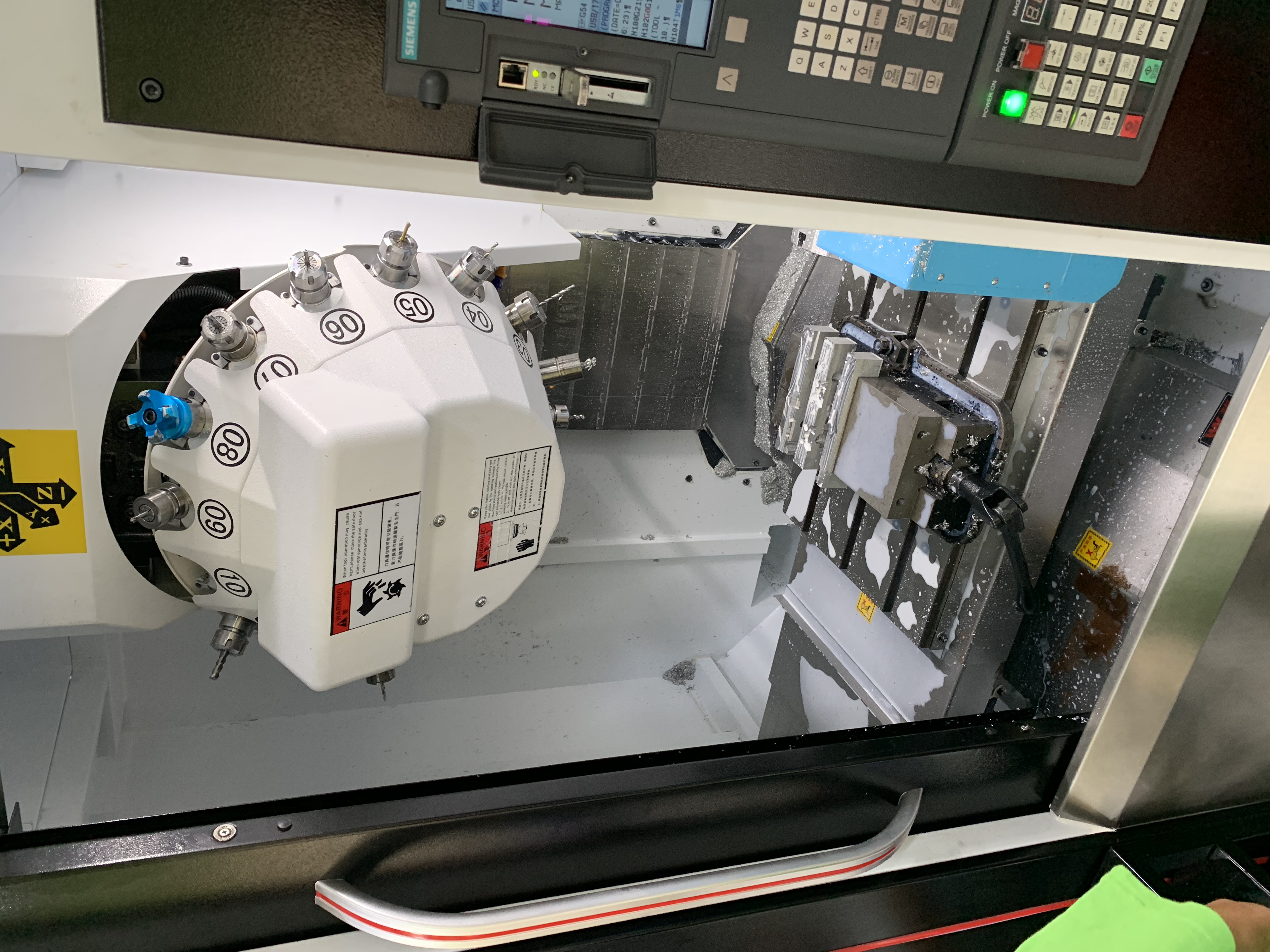
CNC machining has setup, not tooling. Setup means a workholding fixture, a toolpath program, and the time to prove out the first part. That work is real and it costs money, but it is measured in hours rather than weeks, and it does not require capital equipment dedicated to a single part number.
The cost structure follows from that. On a CNC part, programming and setup dominate at low quantity. Material and cycle time scale close to linearly. The first part is expensive and every part after it is cheaper, but there is no point on the curve where a single part becomes impossible to produce. It only becomes expensive per unit.
That is the practical difference. On a molded part, quantity one is not a pricing question, it is unavailable. On a machined part, quantity one is usually a pricing question.
CNC Quantities in Practice
CNC machining is mostly used for prototypes, validation builds, and low volume production. That is what the process is good at: fast turnaround, no tooling, tight tolerances, and a wide material range.
Parts that reach genuinely high volume often do not stay on a CNC machine. A bracket machined from billet during EVT may become a stamping or a casting once the design is frozen and the volumes justify a tool. A machined housing may become an injection molded housing. In those cases the CNC version existed to prove out the design, not to be the production method.
So for a large share of CNC work, the total quantity that will ever be machined is small. That is one reason many CNC suppliers will accept an order for one or two parts. The setup cost shows up in the unit price rather than as a minimum quantity.
Why Some CNC Suppliers Still Set a Minimum
Most CNC suppliers specialize in either prototype work or production work. The two are run very differently.
A prototype shop is built around changeover. Short runs, frequent setups, a wide material mix, fast programming, and pricing that assumes setup is most of the job. Quantity one is routine there.
A production shop is built around throughput. Longer runs, dedicated fixtures, optimized cycle times, and pricing that assumes setup gets amortized across hundreds or thousands of parts. A single part order in that environment interrupts a schedule built on long runs, and the revenue does not cover the disruption. An MOQ is one way the shop protects its capacity.
Neither approach is wrong. They are answers to different problems. The practical issue is that a customer often cannot tell which kind of shop they are talking to until the quote comes back. An engineer who needs one part and happens to reach a production shop gets an MOQ, a long lead time, or a price that reads as a polite decline.
The same split shows up again later. A team that prototypes at a prototype shop may have to re-source the part when volumes increase, because that shop is not set up to run production. The new supplier starts over on programming, fixturing, and first article approval, and the parts may not come out identical to the ones that passed validation.
Secondary Processes and Finishes
Often the MOQ on a CNC quote does not come from the machining at all. It comes from what happens after the machining.
Anodizing is the clearest example. Anodizing runs in tanks. Parts are racked, submerged, and processed as a batch. The chemistry, the labor, and the tank time are close to the same whether the rack holds two parts or two hundred. An anodizer set up to serve production customers has little reason to accept an order for one part, so they either refuse it or apply a lot charge that exceeds the cost of the part.
The same holds for plating, powder coating, painting, passivation, and heat treatment. All of them are batch processes with their own minimums.
This puts the CNC supplier in a specific position. The shop may be entirely willing to machine one part, and often is. What it cannot always do is find a finisher that will process one part on a reasonable schedule at a reasonable price. In those cases the MOQ on the quote is inherited from the finishing supply chain rather than set by the machine shop.
A few ways this gets handled:
- Batch the part with other work going to the same finisher. This works if the shop already runs enough volume in that finish.
- Pay a lot charge or finisher minimum. Straightforward, but it can be surprising on a small order, so it is worth asking about before the quote is approved.
- Substitute a finish with a lower minimum. Bead blasting and tumbling are usually easier at low quantity than anodizing or plating.
- Skip the finish at the prototype stage, if the finish is cosmetic rather than functional.
That last option is common and carries some risk. Hard anodize changes dimensions. Plating changes conductivity and can affect fit on tight tolerance features. A prototype validated without its production finish has not been fully validated. The finish should be skipped only after checking whether it affects fit, wear, corrosion resistance, or electrical properties.
What to Ask a CNC Supplier
Three questions cover most of this:
- Can the supplier quote quantity one with the required finish, and what does it cost? A supplier that quotes a bare machined part at quantity one but cannot handle the finish at that quantity has only answered half the question.
- Does the supplier own the machines, or broker the work? A supplier that owns the machines controls its own schedule and can decide to run a single part. A broker has to find a shop willing to accept it, and that shop sets the terms.
- Can the same supplier carry the part into higher volumes? If not, the part gets re-sourced later and some of the validation work gets repeated.
Where the MOQ Actually Comes From
There is no tooling to amortize on a CNC part, so the minimum on a CNC quote is rarely a property of the part itself. It usually reflects one of two things: a shop optimized for production runs rather than one-off work, or a finishing supply chain with batch minimums of its own.
Both are real constraints, and different suppliers handle them differently. Knowing which one is behind the number makes it easier to tell whether a different supplier, a different finish, or a different quantity would change the answer.
OpusFab quotes CNC parts at quantity one. The machines are owned rather than brokered, so a single part can be scheduled without asking another shop to accept it, and the same supplier carries the part from the first prototype into higher volumes. Finishing is quoted manually rather than instantly, because the batch minimums described above are real and the answer depends on the finish and the quantity.