Aluminum 6061 vs 7075: Which Material to Use for CNC Machined Parts

Aluminum is the most common material for CNC machined prototypes and production parts. Most of that work uses one of two alloys: 6061 or 7075. Choosing between 6061 vs 7075 is one of the most common material decisions product developers face, and those who are not materials specialists often default to whichever one they have used before, without knowing what the actual tradeoffs are. This post explains the differences in plain terms: strength, machinability, price, and the situations where each alloy makes sense.
Composition and Baseline Properties
6061 is an aluminum alloy with magnesium and silicon as the main alloying elements. It has moderate strength, good corrosion resistance, and it welds well. It is the general-purpose aluminum used across most industries.
7075 is an aluminum alloy with zinc as the main alloying element, along with smaller amounts of magnesium and copper. It was developed for aerospace use and has a much higher strength-to-weight ratio than 6061.
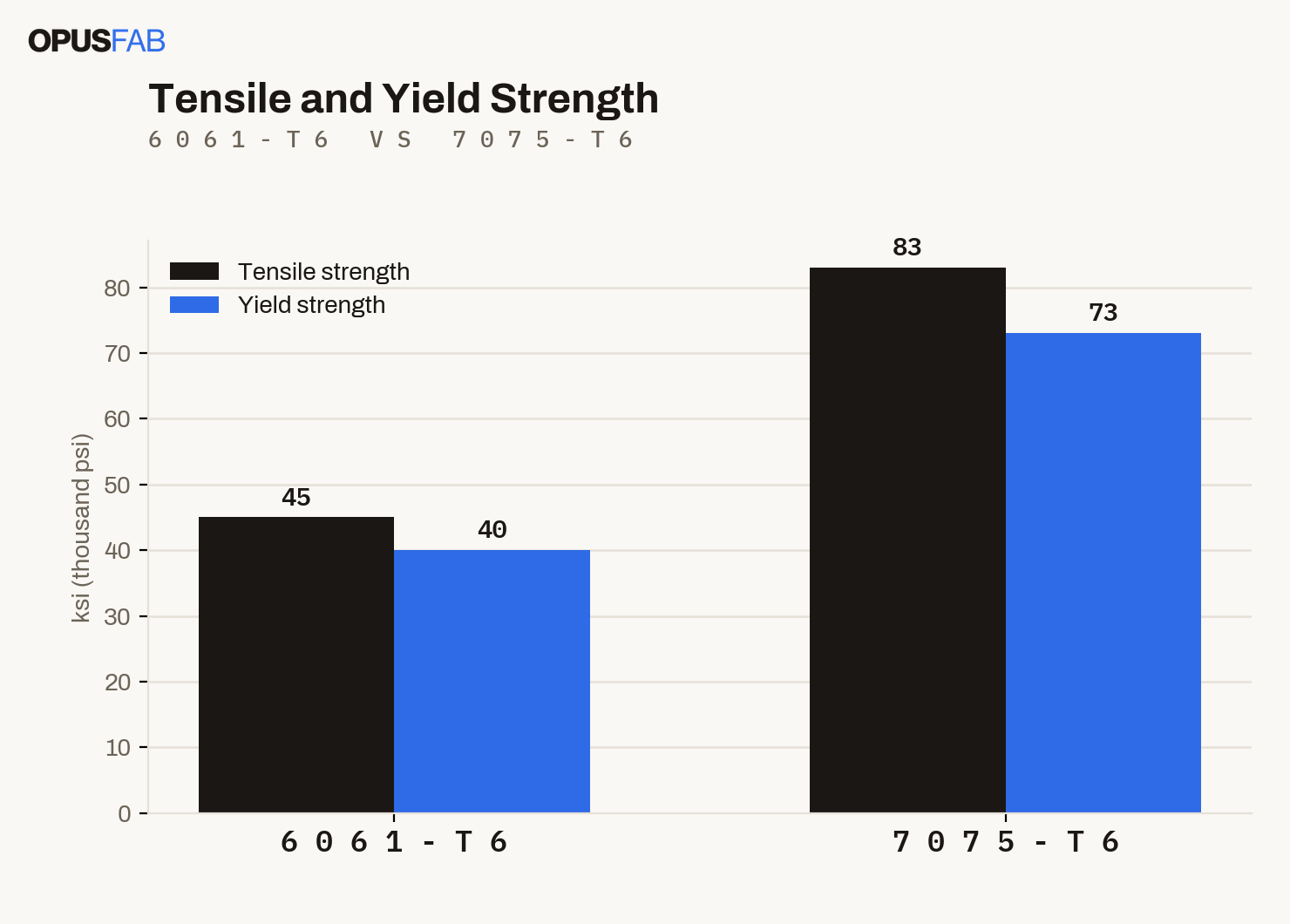
In numbers, 6061-T6 has a tensile strength around 45,000 psi and a yield strength around 40,000 psi. 7075-T6 has a tensile strength around 83,000 psi and a yield strength around 73,000 psi. 7075 is roughly 80 to 90 percent stronger than 6061 by these measures.
Machinability
6061 is one of the easiest aluminum alloys to machine. It cuts cleanly, produces manageable chips, and allows higher cutting speeds and feed rates. Tool wear is low, and it holds tight tolerances without much difficulty. This is a large part of why it shows up in so many parts: shops can run it fast and get a good surface finish without fighting the material.
7075 is harder and more abrasive than 6061. It still machines reasonably well compared to steel or titanium, but cutting speeds usually need to be reduced, tool wear is higher, and the material is more prone to work hardening if the cutting parameters are not right. Shops experienced with 7075 manage this without much trouble, but it takes more attention than 6061 does.
For a shop with standard equipment and standard tooling, 6061 machines faster and with fewer complications. 7075 requires slower speeds and closer control, which adds machine time.
Price Differences
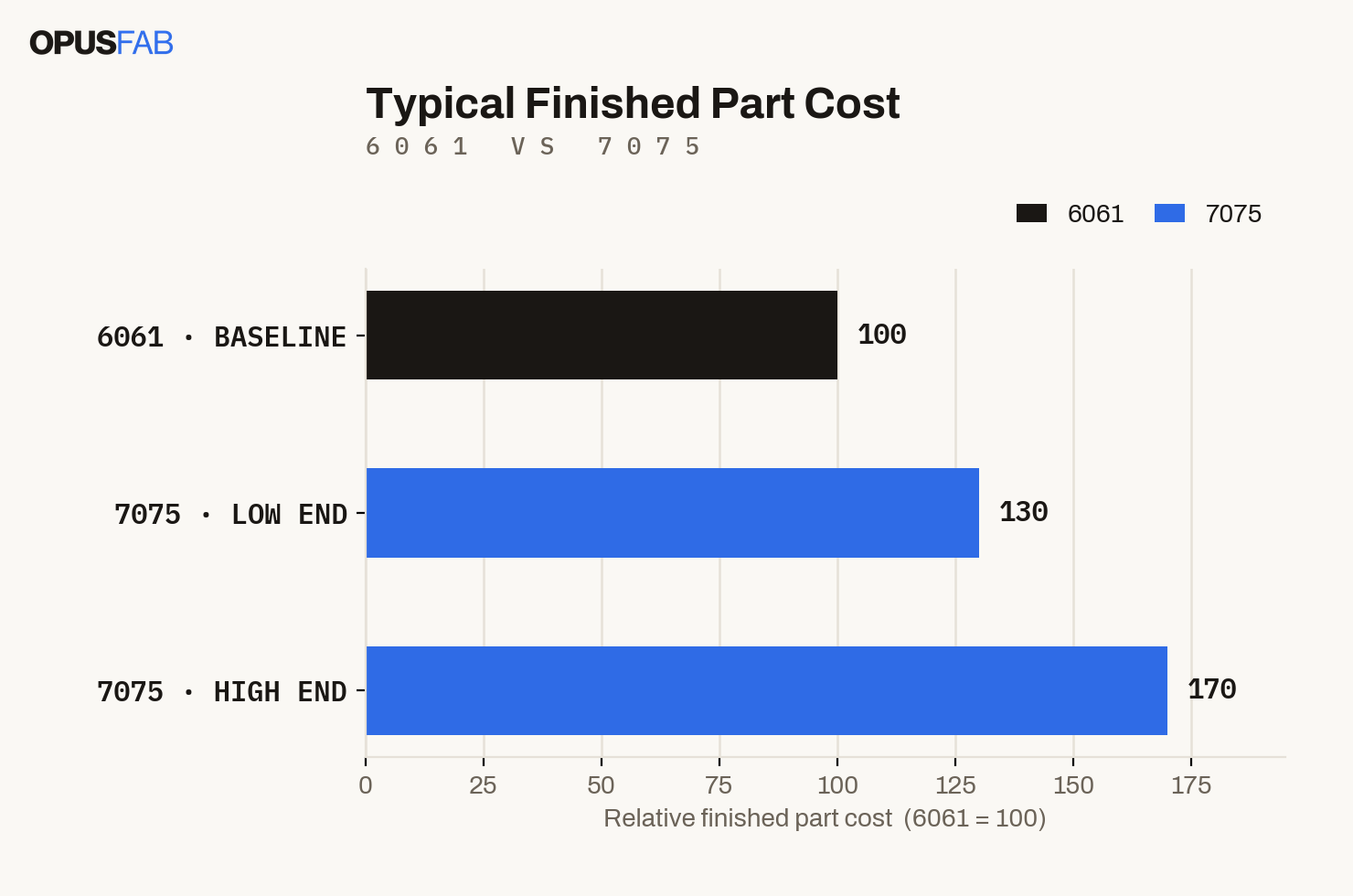
Raw 7075 stock typically costs 30 to 60 percent more than 6061 stock, depending on the supplier and the size of the order. That difference alone would already make 7075 parts more expensive.
The machining difference adds to that gap. Because 7075 requires slower cutting speeds and more careful toolpaths, cycle times are longer, which adds machine time and labor cost. Between the material cost and the added machining time, a 7075 part commonly costs somewhere between 30 and 70 percent more than the same part made in 6061, depending on part geometry and how demanding the tolerances are.
For parts where 6061’s strength is enough, choosing 7075 adds meaningful cost without adding meaningful benefit.
Mechanical Performance
Beyond raw strength, there are a few other differences worth knowing.
Fatigue resistance. 7075 generally performs better under repeated cyclic loading, which matters for parts that flex or vibrate over long service life.
Corrosion resistance. 6061 has good natural corrosion resistance. 7075 is more susceptible to stress corrosion cracking, particularly in parts with high residual stress or in corrosive environments. This is usually managed with proper heat treatment and coatings, but it is a real consideration for parts exposed to moisture or chemicals over time.
Weldability. 6061 welds well using standard methods. 7075 is difficult to weld and is not recommended for welded assemblies. If a design requires welding, 6061 is the practical choice regardless of strength requirements.
When to Use 6061
6061 is the right default for most parts. It fits well for:
- Structural brackets, mounts, and frames
- Enclosures and housings
- Fixtures and jigs
- Parts that will be welded or joined to other aluminum components
- General-purpose prototypes where cost and turnaround matter more than maximum strength
If a part does not have an unusually demanding strength-to-weight requirement, 6061 will almost always be the more practical and more economical choice.
When to Use 7075
7075 is worth the added cost when a part needs strength that 6061 cannot provide at a reasonable weight. This includes:
- Aerospace and drone structural components
- Gears and load-bearing mechanical parts
- High-stress fixtures and tooling
- Parts where every gram matters and strength cannot be compromised
If the design has already gone through DFM review and 6061 will not meet the strength requirement without adding excess material, 7075 is usually the right move.
Finishing and Post-Processing
Both alloys can be anodized, though the process and appearance differ slightly. 6061 anodizes with consistent, predictable color and finish, which is why it is common for parts where cosmetic appearance matters. 7075 can be anodized as well, but the higher alloying content can produce a slightly less uniform finish, and some anodizing types (particularly hardcoat) require more process control to get consistent results.
Finishing also affects final part dimensions, not just appearance. Anodizing and other coatings add thickness, which is why machining tolerance and final tolerance are not the same number. For parts that need a specific cosmetic finish alongside high strength, this is worth discussing with the shop doing the anodizing before finalizing the design.
Comparison Table
| Property | 6061 | 7075 |
|---|---|---|
| Tensile strength | ~45,000 psi | ~83,000 psi |
| Yield strength | ~40,000 psi | ~73,000 psi |
| Machinability | Excellent | Good, but slower and more tool wear |
| Relative cost | Lower | 30-70% higher (material + machining) |
| Corrosion resistance | Good | More susceptible to stress corrosion |
| Weldability | Good | Not recommended |
| Typical use | General-purpose parts, brackets, enclosures | High-strength aerospace and load-bearing parts |
Conclusion
The decision between 6061 and 7075 usually comes down to one question: does the part need strength that 6061 cannot deliver at an acceptable weight and size? If yes, 7075 is worth the added material and machining cost. If the part will hold up fine in 6061, there is little reason to pay the premium for 7075. Starting with 6061 as the default and only moving to 7075 when the strength requirement demands it keeps both cost and lead time under control.
Both alloys can be priced directly through OpusFab’s instant CNC quote tool, which makes it easy to compare the actual cost difference on a specific part before committing to a material.