Two Types of Instant Quote Manufacturing: Marketplaces vs Vertically Integrated

Two very different kinds of companies show up when a buyer searches for instant quote manufacturing. Both put a CAD upload button on the homepage. Both return a price in seconds. What happens after the file is uploaded is not the same.
The first type is the marketplace. It does not own machines. It owns software, a supplier network, and a pricing model. The second type is vertically integrated. The company that quotes the part is the company that makes it.
Both models solve the same immediate problem, which is that traditional quoting takes days. The differences show up in cost, lead time, quality consistency, process range, and accountability. This post covers how each model works, where each one performs well, where each one fails, and how to decide which fits a given part.
What instant quote manufacturing actually means
Instant quote manufacturing means a price is generated from part geometry without a person reviewing the file first.
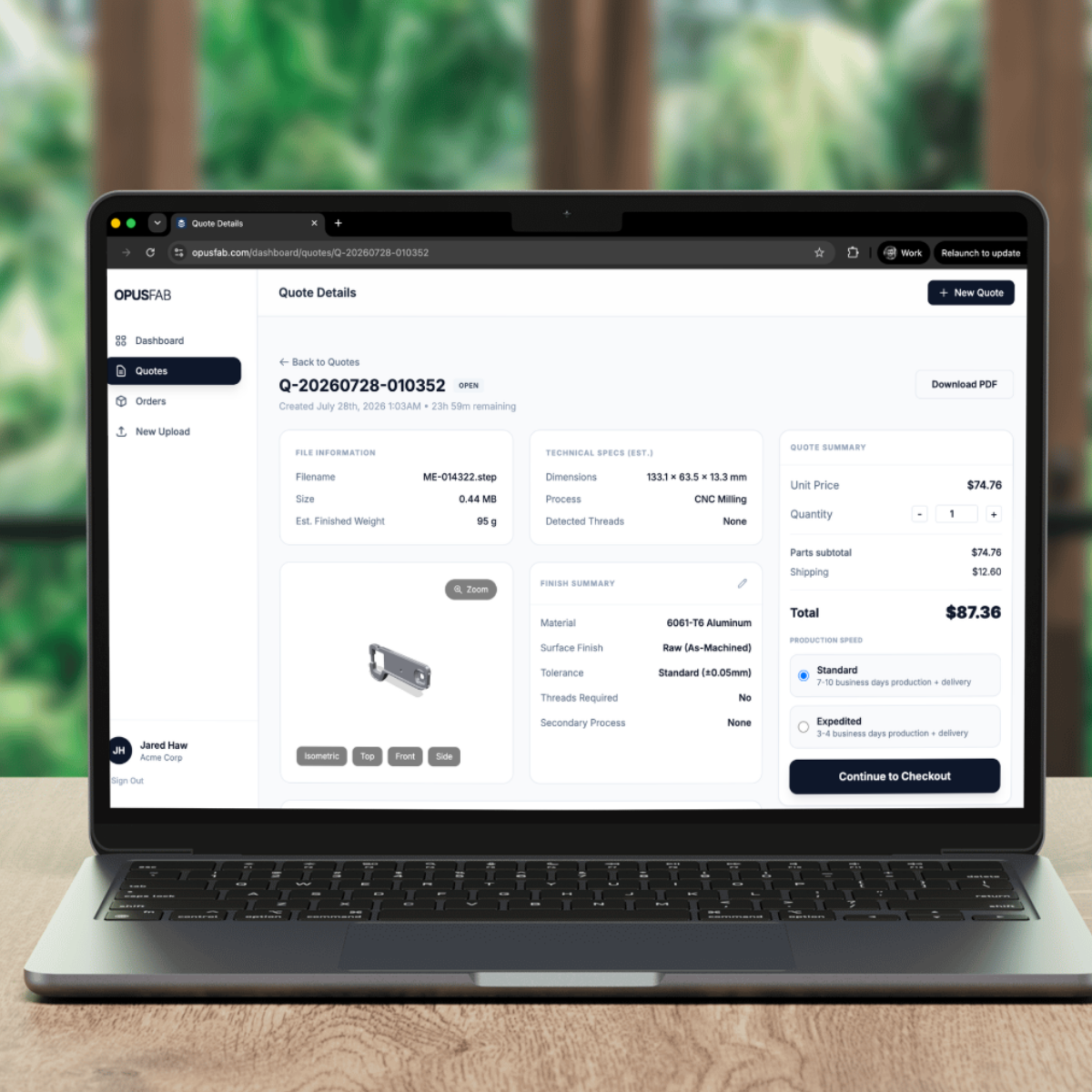
The software reads the CAD model, identifies features such as pockets, holes, bosses, threads, and bends, and estimates the work required to produce them. It applies material cost, machine time, setup time, tooling, secondary operations, finishing, inspection, and quantity breaks. A price and a lead time come back, usually in under a minute.
This replaced the manual RFQ cycle, where a buyer emailed drawings to several shops, waited two to five days for responses, compared inconsistent quote formats, and often repeated the process after a design revision. On a low-value order the review time could exceed the value of the order itself, which is why many shops ignored small RFQs entirely.
The pricing logic is similar across providers. The business model behind it is not.
Model one: the instant quote marketplace
A marketplace sits between the buyer and the manufacturer.
The platform prices the part, takes the order and the payment, and then routes the job to a shop in its supplier network. The shop produces the part. The platform manages the relationship, the schedule, and the margin. The buyer usually does not know which shop received the job.
The supplier network is the core asset. A network of hundreds or thousands of shops covers a wide range of processes, machines, materials, and geographies. Capacity is elastic, because the platform can add suppliers faster than a factory can add machines.
Xometry is the largest example of this model.
Model two: the vertically integrated manufacturer
A vertically integrated manufacturer quotes from its own capacity.
The machines, the production floor, the quality system, and the engineers are inside one organization. The instant quote is generated from the same cost and scheduling data the factory uses to run the job. When an order is placed, it goes onto a machine the company owns, run by an operator the company employs.
The core asset is the production capability itself. Capacity is limited by the number of machines and the size of the floor, and adding capacity requires capital and time.
Cost
The structural difference is the margin layer.
A marketplace price consists of the manufacturing cost charged by the supplier plus the platform’s margin. That margin funds the software, the sales team, the account management, and the platform’s profit. The buyer pays the shop’s price and the platform’s price in a single number.
A vertically integrated price does not include an intermediary. The buyer pays the manufacturing cost and the manufacturer’s margin, and nothing in between.
This argument is structural, not absolute. Marketplace pricing algorithms sometimes quote below cost to win volume or to fill a supplier’s idle capacity, and a well capitalized marketplace can undercut an individual shop on a specific part. The reliable version of the claim is narrower: on repeat production work, a model with one margin layer costs less than a model with two.
Lead time
Both models return a quote in seconds. The lead time to receive parts is a separate question.
A marketplace order has to be routed before it can be scheduled. The platform matches the job to a supplier, the supplier accepts it, and the job enters that supplier’s queue. If a supplier declines or misses the date, the platform reassigns the job, and the clock restarts. Routing is invisible to the buyer, so a delay is often only visible once the promised ship date has passed.
A vertically integrated order goes straight into one production schedule. There is no acceptance step and no reassignment. Machine availability, material stock, and finishing capacity are all known at the time of quoting, which makes the promised date a function of the factory’s own queue rather than a third party’s.
The marketplace advantage appears at volume spikes. A network can absorb a surge across many shops. A single factory can run out of machine hours.
Quality consistency
This is where the two models diverge most over time.
A marketplace routes each order independently. A part ordered in March and reordered in September can be produced by two different suppliers, on different machines, with different fixtures, different operators, and different inspection standards. Both parts can meet the drawing and still differ in surface finish, edge condition, and where they sit inside the tolerance band. For a prototype, that is usually acceptable. For a part going into an assembly or into validation testing, it introduces variables that are difficult to trace.
A vertically integrated manufacturer runs the reorder on the same machine, with the same program, the same fixture, and the same inspection process. Process knowledge accumulates. When something goes wrong, the history of the part exists in one place.
Process range
This is the clearest marketplace advantage.
No single factory covers every process. A supplier network can offer CNC machining, sheet metal, injection molding, die casting, urethane casting, additive processes, and a long list of finishes and treatments, because each of those capabilities lives at a different member of the network. For a buyer with a mixed bill of materials, one platform can cover the whole list.
A vertically integrated manufacturer offers what it owns. Expanding the process range means buying machines and hiring people, so the list grows slowly. Parts outside that list either move to a partner shop or are quoted manually rather than instantly. A provider that is direct about which processes are instant and which are not is easier to plan around than one that presents everything as instant and quietly routes the difficult work elsewhere.
Control and accountability
The difference shows up when a part is wrong.
In the marketplace model, the buyer contacts the platform, the platform contacts the supplier, and the supplier investigates. The engineer who wrote the CNC program and the engineer who inspected the part are two steps removed from the person who needs the answer. Rework runs through the same routing process as the original order. The platform’s incentive is to resolve the ticket, and the supplier’s incentive is to protect its rating within the network, which are not the same thing as fixing the root cause of the defect.
In the vertically integrated model, the buyer contacts the manufacturer, and the manufacturer has the part history, the program, the material certificates, and the inspection records. The people who made the part can be asked directly what happened. Responsibility does not move.
| Marketplace | Vertically integrated | |
|---|---|---|
| Owns machines | No | Yes |
| Quote speed | Seconds | Seconds |
| Cost structure | Manufacturing cost plus platform margin | Manufacturing cost only |
| Lead time driver | Supplier routing and acceptance, then supplier queue | One production schedule |
| Repeat order consistency | Varies, supplier may change between orders | Same machines, program, and inspection process |
| Process range | Wide, limited by network breadth | Narrower, limited by owned equipment |
| Capacity at volume spikes | Elastic across the network | Limited by floor and machine hours |
| Who answers a quality issue | Platform, coordinating with an unnamed supplier | The manufacturer that made the part |
| Visibility into production | Limited, supplier identity often withheld | Direct access to the factory and its records |
When a marketplace is the right choice
A marketplace fits when breadth matters more than cost and consistency.
The clearest cases are one-off parts, a process no single factory offers, low volume work spread across many different manufacturing methods, and short term capacity surges that exceed what one plant can absorb. A buyer producing five unrelated parts across five processes, once, is better served by one platform than by five separate supplier relationships.
When a vertically integrated manufacturer is the right choice
A vertically integrated manufacturer fits when the same part will be made more than once.
The clearest cases are repeat orders, cost sensitive production, tight tolerances, parts that require traceable process history, and any program moving from prototype through validation into production. The value of running each build on the same equipment increases with every revision, because differences between builds can be attributed to the design rather than to the supplier.
How to evaluate an instant quote provider
Five questions separate the two models quickly.
- Does the provider own machines, or does it route work to a network.
- Does the quote include manufacturability feedback before the order is placed, or does the first quality conversation happen after parts ship.
- Will a reorder be produced on the same equipment as the original order.
- Who investigates when a part fails inspection, and what records are available.
- Which processes are actually instant, and which are quoted manually.
The last question matters most, because both models present a single upload button regardless of what happens behind it.
Summary
Marketplaces sell breadth. Vertically integrated manufacturers sell cost, consistency, and accountability.
A marketplace is the better answer for variety, for one-off parts, and for processes that no single factory offers. A vertically integrated manufacturer is the better answer for repeat orders, for cost sensitive production, and for any part that has to be made the same way twice.
The instant quote itself is not the differentiator. Both models return a number in seconds. The question worth asking is what sits behind that number.